Understanding an Aneurysm After a Car Collision
By: James D . Spiros | Last Reviewed & Updated: May 14, 2026
Learning you have an aneurysm after a car accident can feel overwhelming. A crash puts sudden and intense force on your body. That force can damage blood vessels or place strain on a weak area that already existed.
In some cases, the accident may trigger the aneurysm. In others, doctors may discover it while checking you for crash related injuries.
This section explains how an aneurysm can affect your health and helps you understand what legal options may be available to you.
What is an Aneurysm?
An aneurysm happens when part of an artery becomes weak and swells outward. It looks like a
balloon pushing out from the side. Arteries are blood vessels that move oxygen rich blood from your heart to the rest of your body. When a spot in the artery wall loses strength, the pressure from blood flow can cause it to puff out and form an aneurysm.
Most aneurysms do not cause pain. Many people do not know they have one. Problems often start only if the aneurysm breaks open. A rupture can lead to serious harm and can be life threatening.
Disclaimer: This content is for informational purposes only and is not medical or legal advice. Always seek prompt medical care for suspected injuries.
Why Medical Bills Are So High
Treating an aneurysm is very expensive. You are likely seeing many specialists and facing high costs for things like:
- Emergency Room Visits: Tests like CT scans and MRIs to find the bulge.
- Surgery: Procedures to fix the artery before it leaks.
- Hospital Stays: Time spent in the intensive care unit for monitoring.
- Follow Up Care: Regular checkups to make sure the artery stays strong.
Lifestyle Changes You May Face
An aneurysm diagnosis often means you have to change how you live to stay safe. Common changes include:
- Work Limits: You might not be able to do heavy lifting or stressful jobs.
- Activity Levels: Doctors often tell patients to avoid intense exercise.
- Daily Help: You may need someone to help with chores or driving while you recover.
Seeking Legal Help
When an accident caused by someone else leads to an aneurysm, you may be able to get help paying for your bills. A legal professional can help you with:
- Proving the Accident Caused the Harm: Lawyers work with doctors to show that the crash led to your medical issues.
- Managing Insurance Companies: They talk to the insurance adjusters so you do not have to.
- Recovering Lost Wages: If you cannot work, a legal claim can help replace that money.
- Future Costs: They calculate how much money you will need for medical care for the rest of your life.
Statistics and What They Mean for You
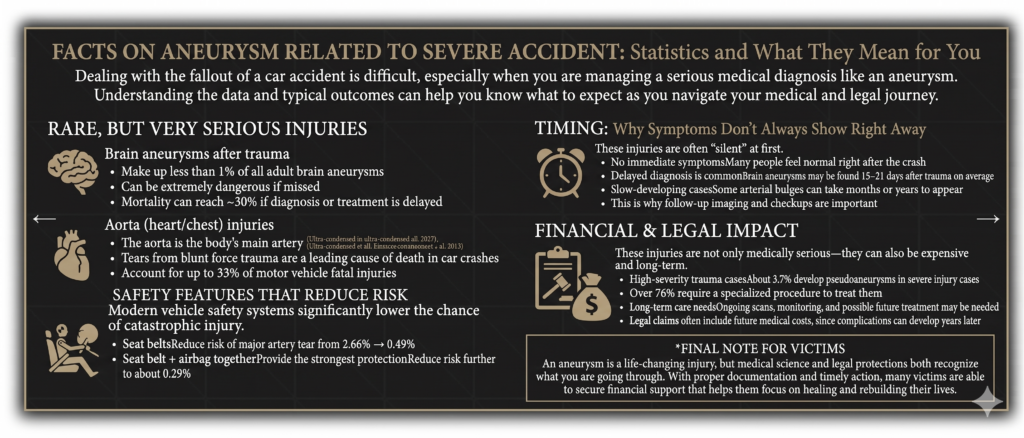
Dealing with the fallout of a car accident is difficult, especially when you are managing a serious medical diagnosis like an aneurysm. Understanding the data and typical outcomes can help you know what to expect as you navigate your medical and legal journey.
Rare, But Very Serious Injuries
Accident-related aneurysms (also called traumatic aneurysms or pseudoaneurysms) don’t happen often—but when they do, they are high risk.
- Brain aneurysms after trauma
- Make up less than 1% of all adult brain aneurysms (Govindaraju, 2026; Chiriac et al., 2013)
- Can be extremely dangerous if missed
- Mortality can reach ~30% if diagnosis or treatment is delayed (Govindaraju, 2026)
- Aorta (heart/chest) injuries
- The aorta is the body’s main artery
- Tears from blunt force trauma are a leading cause of death in car crashes
- Account for up to 33% of motor vehicle fatal injuries (Benjamin & Roberts, 2012; Harper, 2024)
Timing: Why Symptoms Don’t Always Show Right Away
These injuries are often “silent” at first.
- No immediate symptoms
- Many people feel normal right after the crash
- Delayed diagnosis is common
- Brain aneurysms may be found 15–21 days after trauma on average (Govindaraju, 2026; Chiriac et al., 2013)
- Slow-developing cases
- Some arterial bulges can take months or years to appear
- This is why follow-up imaging and checkups are important (Özdem, 2026)
Safety Features That Reduce Risk
Modern vehicle safety systems significantly lower the chance of catastrophic injury.
- Seat belts
- Reduce risk of major artery tear from 2.66% → 0.49% (Benjamin & Roberts, 2012)
- Seat belt + airbag together
- Provide the strongest protection
- Reduce risk further to about 0.29% (Benjamin & Roberts, 2012)
Financial & Legal Impact
These injuries are not only medically serious—they can also be expensive and long-term.
- High-severity trauma cases
- About 3.7% develop pseudoaneurysms in severe injury cases
- Over 76% require a specialized procedure to treat them (Scheuermann et al., 2023)
- Long-term care needs
- Ongoing scans, monitoring, and possible future treatment may be needed
- Legal claims often include future medical costs, since complications can develop years later
*Final note for victims
An aneurysm is a life-changing injury, but medical science and legal protections both recognize what you are going through. With proper documentation and timely action, many victims are able to secure financial support that helps them focus on healing and rebuilding their lives.
Frequently Asked Questions: Aneurysm Survival and Recovery
What is the survival rate for an unruptured aneurysm?
The outlook for an unruptured aneurysm is very strong. According to the National Institute of Neurological Disorders and Stroke, many never cause symptoms. For planned procedures such as clipping or coiling, success rates are often 95% or higher, as supported by the Brain Aneurysm Foundation.
If an aneurysm ruptures, what are the chances of survival?
A ruptured aneurysm is a medical emergency, but survival rates continue to improve. Research from the National Center for Biotechnology Information shows about 60% survive. The American Association of Neurological Surgeons reports that 2 out of 3 survivors have no or only mild long-term damage with fast treatment.
Does a traumatic aneurysm from an accident have a different outlook?
Yes. A study in the Journal of Trauma and Acute Care Surgery found that early diagnosis and quick treatment are the most important factors for survival. Death rates for patients who reach the hospital and receive prompt care have continued to decline.
Can I live a normal life after aneurysm treatment?
For many, yes. The American Heart Association states that many patients return to work and hobbies. Lifestyle changes like controlling blood pressure or quitting smoking often improve overall health long-term.
What factors improve survival and recovery?
According to the Mayo Clinic and the CDC, recovery chances improve with:
- Fast medical care: Early scans and testing after symptoms or an accident.
- Specialized treatment: Care at hospitals experienced in stroke and vascular conditions.
- Ongoing monitoring: Follow-up CT or MRI scans to ensure stability.
- Rehabilitation support: Therapy to rebuild strength and function.
Can a car accident or serious injury cause an aneurysm?
Yes. According to the National Institutes of Health, blunt force trauma to the head or neck can damage blood vessel walls and lead to a traumatic aneurysm (pseudoaneurysm).
Can I file a personal injury claim if an accident caused my aneurysm?
Yes. The CDC explains that traumatic vascular injuries can result from crashes. When a doctor links the aneurysm to trauma, that medical opinion supports a legal claim.
What if I had an aneurysm before the accident?
You may still have a valid claim. The NINDS states that aneurysms can remain stable for years and then worsen due to injury. If an accident made a previously silent aneurysm dangerous, the accident may be legally responsible.
What damages can I recover after an aneurysm injury?
According to the U.S. Department of Justice, damages can include medical bills, lost income, future care needs, and pain and suffering when negligence caused the injury.
Can I recover compensation for long-term disability or brain damage?
Yes. The American Association of Neurological Surgeons confirms that aneurysms can lead to permanent neurological limitations, which are compensable in injury claims.
How important are medical records in an aneurysm injury case?
They are critical. According to the National Library of Medicine, imaging studies like CT, MRI, and angiograms are the primary tools used to determine the cause and serve as legal proof.
Is there a time limit to file a lawsuit after an aneurysm injury?
Yes. The Legal Information Institute explains that every state has strict statutes of limitations. The clock may start when the aneurysm is discovered or when the accident occurred.
*Important note
These statistics show overall trends, not individual outcomes. Every case is different. Your doctors are the best source for advice based on your personal health, injury, and medical history.
Even with a serious diagnosis, many people move forward, recover, and regain control of their lives with the right care and support.
Need to File Civil Lawsuit in Illinois?
Contact Spiros Law for free consultation. $0 Upfront Attorney’s Fee.
Sources & Further Information
Sources
- National Institute of Neurological Disorders and Stroke (NINDS): Cerebral Aneurysms Fact Sheet
- National Center for Biotechnology Information (NCBI): Traumatic Aneurysms Following Head Injury
- American Association of Neurological Surgeons (AANS): Cerebral Aneurysm Symptoms and Outcomes
- Centers for Disease Control and Prevention (CDC): Traumatic Brain Injury & Concussion Data
- U.S. Department of Justice (DOJ): Civil Resource Manual: Personal Injury and Damages
- Legal Information Institute (LII): Statute of Limitations in Civil Cases
Medical Resources
- Types of Aneurysms: Learn the difference between saccular, fusiform, and traumatic pseudoaneurysms at the Brain Aneurysm Foundation.
- Vascular Trauma: Explore how blunt force trauma impacts the circulatory system through the Society for Vascular Surgery.
- Imaging and Diagnosis: Understand how CT Angiograms and MRIs identify arterial wall weaknesses via RadiologyInfo.org.
Legal and Recovery Support
- Calculating Future Damages: Review how medical experts determine the long-term costs of vascular monitoring and care at the American Bar Association.
- Navigating Brain Injury Recovery: Find support groups and rehabilitation resources for neurological trauma at the Brain Injury Association of America.
- Insurance Coordination: Learn about your rights regarding medical “Letters of Protection” and insurance subrogation after a major accident.
- Legal Support: Spiros Law practices in the state of Illinois with an acclaimed legal team known for top peer reviews, multimillion-dollar settlements for past clients, and over three decades of experience in personal injury law and civil litigation. Free case review with $0 upfront attorney fees.
Spiros Law Helpful Articles & Blogs
Disclaimer: This content is for informational purposes only and is not medical or legal advice. Always seek prompt medical care for suspected injuries. Viewing this page does not create an attorney-client relationship. Past results do not guarantee future outcomes. Attorney advertising. Spiros Law is licensed in Illinois.